

Why is New York City Rallying Behind a Kalshi Advertisement?
An investigation

The vibes are good in New York City. Since the coldest winter in recent memory gave way to spring and early summer, New York appears to have transformed itself into a sort of utopian metropolis; wunderkind mayor Zohran Mamdani continues to read the political landscape fluently and capably, dolphins are swimming under the Verrazano, and the Knicks are trouncing teams on the way to what appears preordained to be their first NBA championship in more than half a century. Every last bit of New York’s current bacchanalia runs downstream of this final point. Each Knicks win sets in motion a cascade of celebration on the streets, in the bars, and outside of Madison Square Garden. Fans and clout chasers alike flock to man-on-the-street interviews in an attempt to most colorfully perform their New York citizenship, strangers celebrate in the streets, concerts run late with mayoral permission; Fat Joe claims to see Hasidic children breakdancing with their Black neighbors, and video evidence proves the story only slightly apocryphal. The Knicks’ domination has sent the city into an almost self-parodic free-for-all, rendering the city into its most blissful caricature, while at the same time this good-vibe-ouroboros serves as confirmation for all New Yorkers that the Knicks have destiny on their side. A Knicks win turns New York into the greatest city in the world, and the Knicks win because New York is the greatest city in the world. Here is a holistic groundswell of good vibes that demands a more expansive battle cry than a simple “Let’s Go Knicks.” Enter, then, the all-encompassing mantra that has transformed, overnight, into the catchall slogan for this Pax Knickerbocka: “My mayor Muslim, my bagels Jewish, my Christian Dior, Knicks in four!”
This rallying cry originates, like nearly all modern Knicks lexicography, from a viral man-on-the-street interview filmed outside of Madison Square Garden after the Knicks, playing in San Antonio, took a 1-0 lead in the NBA Finals. The fact that people congregated outside of Madison Square Garden despite the game not being played there in the first place is instructive, in its own right, of the ecosystem that has so reliably blasted Knicks fan content out into the internet since relaxed pandemic restrictions made mass public celebration possible once more in 2021. What’s so odd about this video, the contents of which have been repeated by multiple New York City council-members and plastered upon no shortage of hats and t-shirts, is not that it features a man in Knicks attire shouting something ludicrous into a microphone on the streets of Midtown; that, by now, is the water we swim in. What’s striking is that it is an advertisement for the gambling platform-qua-“prediction market” Kalshi.
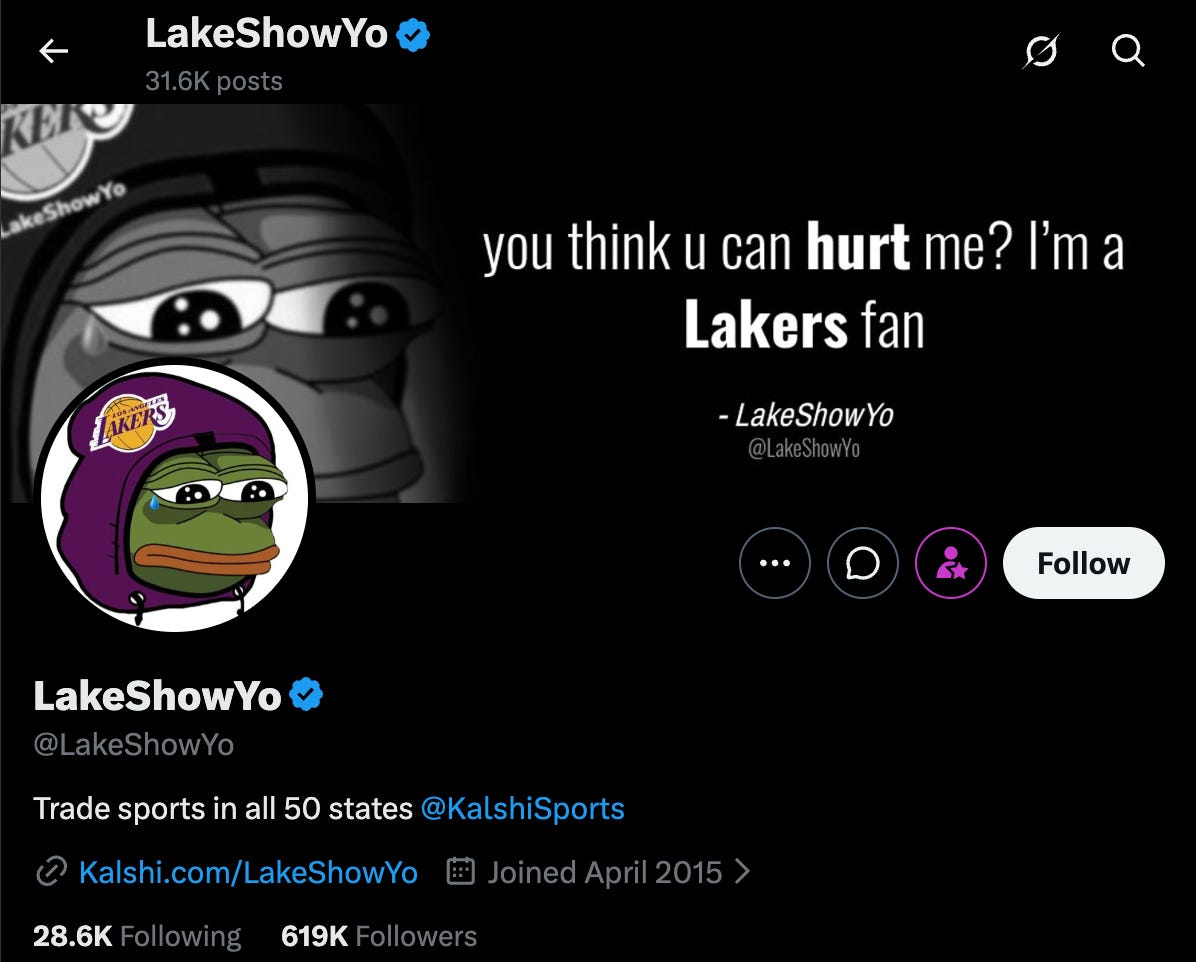
How, one is forced to wonder, have so many people—including those with genuine political power and platforms—found themselves so taken by an advertisement for a gambling company that distinguishes itself from its competitors primarily by the fact that it bans “markets on death?” To answer that question, one must dirty their hands untangling the intertwined webs of “content creation,” “influence,” and gambling, an endeavor that makes one feel less like Claire Danes in Homeland than like a person who, halfway through a first date, realizes that they have forgotten to shower. The “Mayor Muslim” quatrain—which as of this writing boasts at least 21 million views on X, six hundred and forty thousand likes on Instagram, and 6.9 million views on TikTok—first entered X timelines through the influential and abhorrent Los Angeles Lakers fan account “LakeShowYo.” Yo, whose posts primarily concerned his beloved Lakers until a particularly traumatic face reveal by Devin Booker (we live in fallen times) pushed him into a sort of House of Highlights-lite style of posting, shared the clip with the caption “Knicks fans are insane,” followed by a series of crying emojis.

This post, in and of itself, raises few eyebrows. It’s commonly understood throughout the sports internet that Knicks fans are inclined toward a sort of performative debauchery rivaled only by Philadelphia and Buffalo sports fans, and it’s common if regrettable practice for accounts to post clips ostensibly outside of their purview in order to generate monetized engagement. The clip is styled exactly like a video created by Sidetalk, a man-on-the-street interview show created by two then-NYU students in 2019 (one of whom, in a nod to how deep this rot runs, interned for joke-stealing account “The Fat Jewish” when he was fourteen years old) that would become synonymous for its animalistic representations of Knicks fans celebrating their team’s greatness and denigrating their real and imagine opponents. Sidetalk’s New York City is one in which every shoe is a Timb, every store is a bodega, every lunatic is an edit away from a Safdie brother movie role, and every Knicks win brings the city one day closer to mass unrest at the hands of drunken men dressed as Spiderman. Sidetalk is the reason that Knicks fans, five years later and one team removed, chant “Fuck Trae Young;” so, too, is it the genesis of the now-discarded rallying cry “Bing Bong.” In other words, Sidetalk meaningfully transformed New York City—primarily through the vector of performative Knicks fandom—into a place meant to be memed and performed by rambunctious crowds in service of content creation. A friend who is a Knicks season ticket holder tells me that, in the age of Sidetalk, he sees as many people walk toward Madison Square Garden as away from it after a big Knicks victory; a social media outfit purportedly tasked with documenting how insane New Yorkers are has meaningfully rewired the city such that New Yorkers are encouraged to act insane for their cameras.
There’s not much to differentiate the “Mayor Muslim,” video, in form or substance, from a standard Sidetalk hit aside from the fact that the microphone in question bears a Kalshi logo, the Knicks jerseys in it have Kalshi sponsor patches sewn on, and the “Fuck Trae Young”-groaning robot at its heart is Kalshi’s proprietary Knicks-fan robot, “Bing Bot.” One can gather as much by even a cursory scroll through the TikTok account that originally shared the video, a brand-new page by the name of “itsbingbot” that captures the Kalshi robot getting sturdy with Knicks fans and a coterie of slightly off-kilter hypemen in service of expanding Kalshi’s brand recognition. Bing Bot, for its part, only has about two thousand followers on Instagram, a figure that is surprising only in that it suggests the existence of at least two thousand people who would like to stay abreast of the Kalshi robot’s journeys through New York City. Here, then, is where it comes full circle: LakeShowYo, the aforementioned, lowbrow content aggregation account that reposted the robot/“Mayor Muslim” clip and rendered it viral, is either a Kalshi employee or an active participant in a Kalshi promotional deal such that he now posts “@KalshiSports” in his Twitter bio.
Through tracing the life cycle of the “Mayor Muslim” clip, as well as any of the by-now-countless LakeShowYo-boosted bits of Kalshi propaganda masquerading as Madison Square Garden ethnography, one can ascertain the outlines of a new sort of advertising apparatus. Kalshi partners with “content creators”—here, the Kalshi ad Sidetalk-dupe was shot by a group of content creators, dubbed “Off The Glass TV,” who appear to have made their names by conducting fan-on-the-street interviews in which they ask unsuspecting NBA fans their opinions about Darren Watkins Jr., who is not in fact an NBA player but the government name of the uber-popular streamer, IShowSpeed—to create outrageous Sidetalk-style video footage, from which clips are astroturfed into virality by other, apparently unaffiliated Kalshi employees. Lest the impression emerge that this is a Kalshi-specific phenomenon, it bears noting that these “Off The Glass” gentlemen seem to have performed a similar function for the competitor gambling application “PrizePicks.” Meanwhile, Polymarket, Kalshi’s primary competitor in the “prediction market” space, has sponsored a young man who camped outside of Madison Square Garden with the goal of repeating the name “Jalen Brunson” one thousand times (Mr. Beast, it should be said, achieved his own notoriety in part for a live stream during which he counted to one hundred thousand), while FanDuel has deputized radio hosts to hand out subway fare and FanDuel merchandise to anybody in a Knicks jersey.1 One recalls the dustup caused from the early-year revelation that the PR agency “Chaotic Good” used a series of fake social media accounts to drum up artificial interest in musical acts like Geese, Mk.gee, and Dijon, a story that prompted a period of brief period of mass psychosis during which many convinced themselves that Geese, such as it were, was a psy-op. Such thinking—that internet-native, covert marketing points to a broader conspiracy—misses a more salient point: contemporary advertising is so hard to spot because it slots neatly into an internet apparatus in which run-of-the-mill users share the exact same incentive structure as traditional advertisers.
It’s not obvious who is coordinating this stuff, but public job listings indicate that whoever it is is making a fortune. As Emily Sundberg tweeted out basically unnoticed in October of 2025, Kalshi had publicly posted a job listing for “Marketing & Stunt Man (or Woman, or Whatever) [sic],” a role that entails making it “so when there’s something trending, people think of Kalshi.” The position, which is a fit for a candidate “good at noticing trends and making stuff go viral,” pays between $50 thousand and $8 million. One suspects that the Stunt Man, Woman, or Whatever has bumped their salary nicely up that range in the wake of their recent Draperian work.


This job listing is instructive. The function of this sort of viral advertising is not to assert any specific feature of Kalshi—these videos’ rabid congregants are not barking about parlays—as much as it is to make “people think of Kalshi.” If Don Draper’s fictional masterstroke was the notion that “other cigarettes give you cancer, [while] Lucky Strike is toasted,” Kalshi’s Stunt Person’s gambit assumes that their target audience is already going to be gambling, and so their job is to make sure they go to Kalshi first. It’s the sort of advertising campaign you can afford to run when your socially deleterious, highly addictive product has already achieved total cultural dominance, when the question is not whether someone will partake but rather with whom they will spend their money. Kalshi: My Mayor Muslim.
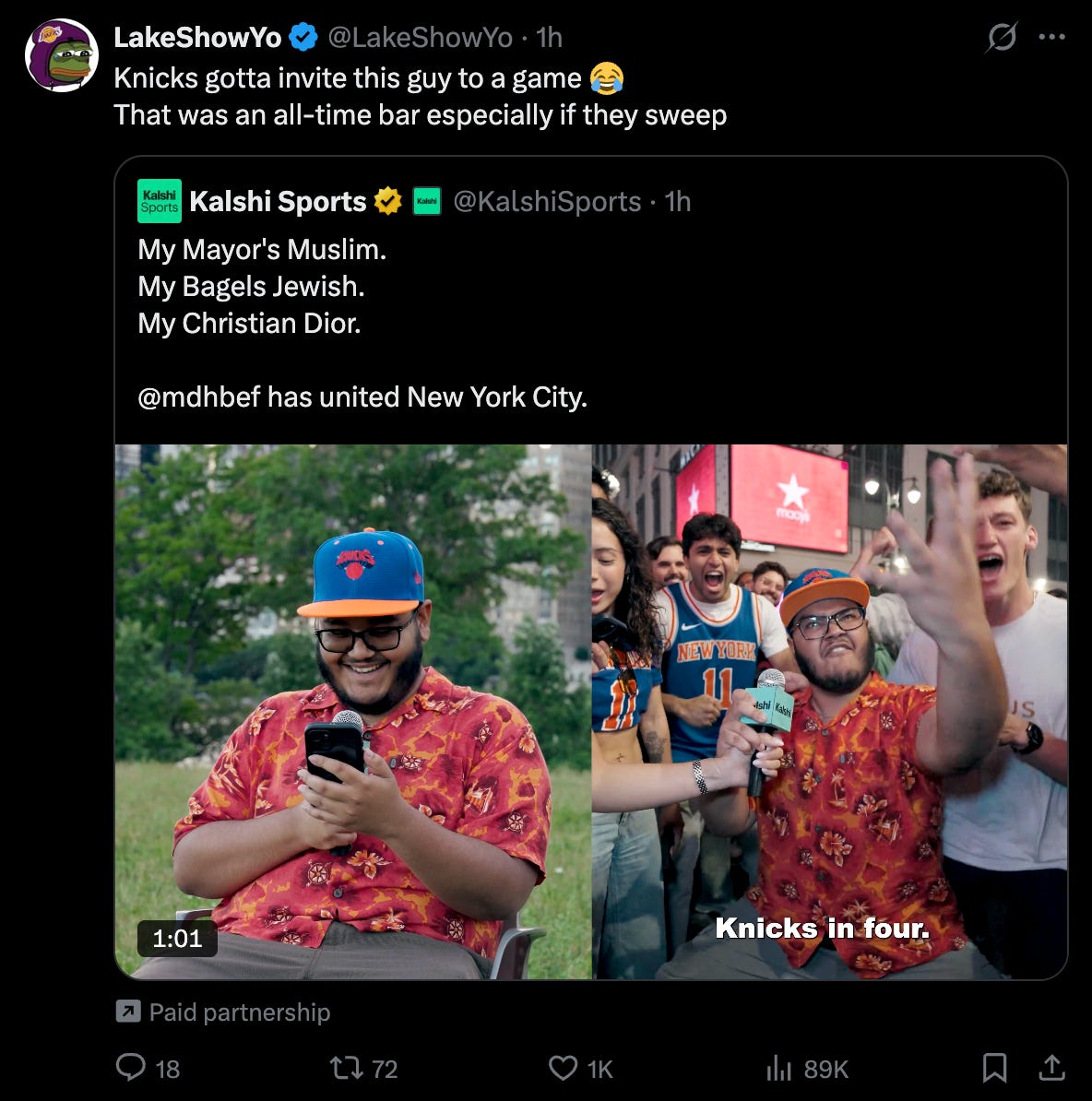
There’s a notion, somewhere in the corner of the internet not completely eager to uncritically boost Kalshi advertisements, that such advertising constitutes the company’s “hijacking” of Knicks fandom. It’s not clear to me that that’s the case—nor, for that matter, is it clear that something that can plausibly be recreated by a robot can be hijacked in the first pace. In preparation for this piece, I was able to identify the man whose (arguably plagiarized) words have united a city and delighted Kalshi’s marketing team. MD Hossain seems like a genuinely good person—his timeline evinces sincere concern for the plight of the Palestinian people—and a lifelong Knicks fan. As we were coordinating a time to speak, I sifted through my questions for him, which aside from a few inquiries into his preferred rhyme scheme centered around why he went to celebrate at Madison Square Garden after Game 1 and whether he knew he was creating content for Kalshi. Before we were able to find a time to speak, he was featured in a second bit of Kalshi advertising.

In the subsequent Kalshi video, which ends with the good folks at Kalshi Sports gifting him a bagel and a Christian Dior scarf, Hossain answers my questions for me. Per Hossain, he ran to MSG to celebrate with other Knicks fans, at which point he saw “Kalshi’s iconic green mic.” Hossain’s eyes light up as he delivers that particular piece of product placement, the look of a man who knows that he’s, however improbably, hit a jackpot. I’m hard-pressed to disagree with Hossain’s implicit acknowledgement of the fact that there is nothing “more authentic” about Sidetalk’s manufactured chicanery than any other form of paid promotion—the whole endeavor is a rancid pile of slop meant to turn clout into other peoples’ cash. The documentary-style interview has already been reposted by LakeShowYo, who suggested that the Knicks should invite Hossain to a game in a post that has been helpfully tagged as a paid partnership. I would bet my entire student loan balance on Kalshi buying Hossain a Finals ticket for their next big stunt, but I can’t think of a place that allows me to wager on future events.
In a rare moment of White House-gambling application antagonism, this promotion was announced mere hours before Donald Trump’s attendance of game three prompted a full pedestrian shutdown of a multi-block radius outside of Madison Square Garden.
This got me thinking of Kalshi, I should really gamble more
Also reminds me of that Mad Men episode where Peggy paid the two actors to fight over a ham and then had to bail one out of jail